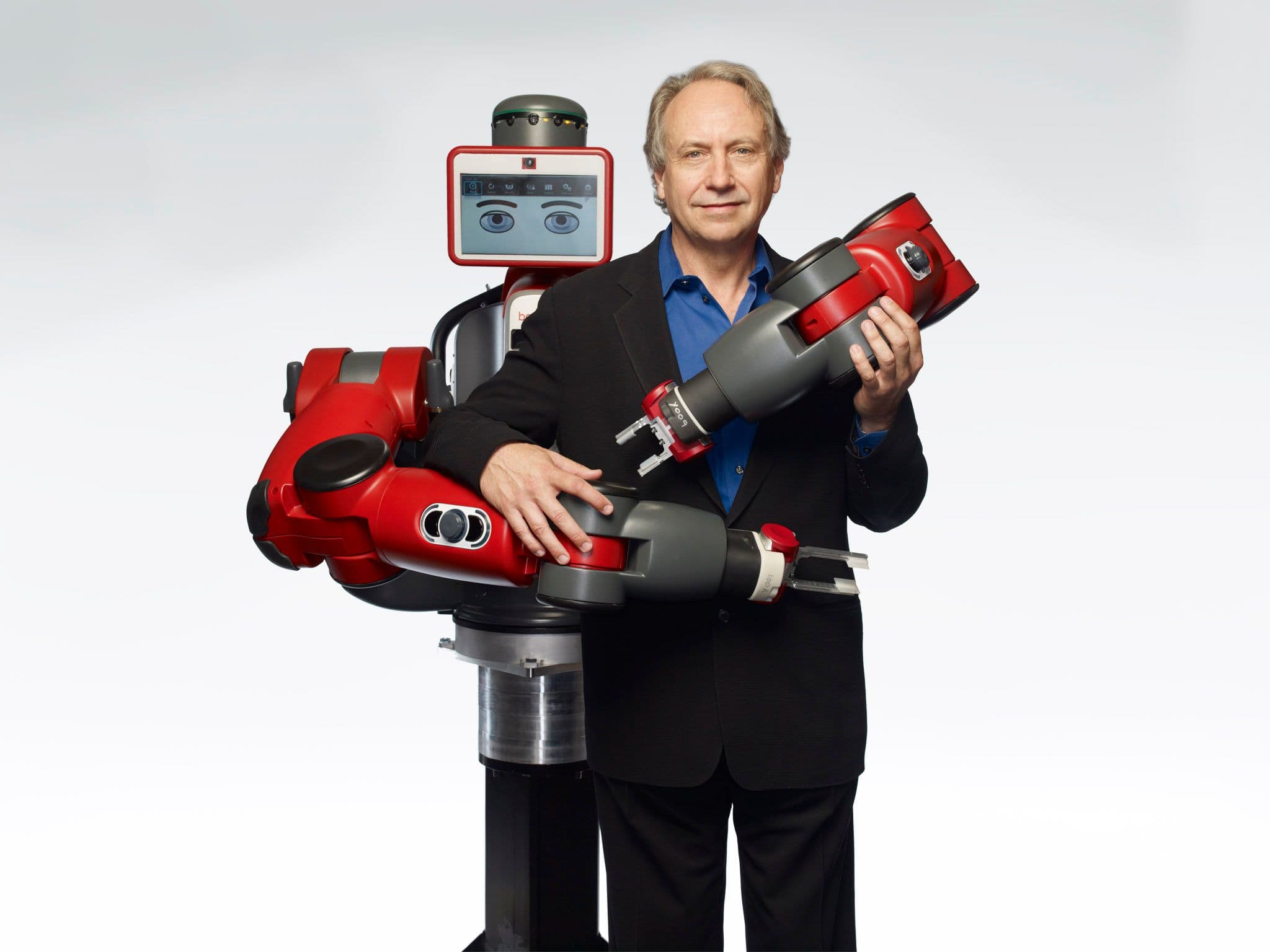
Baxter
Dual-arm collaborative industrial and research robot
Price
Historical record
No current purchase price is documented.
Key facts
Values reflect the public record
- Height
- 3 ft 1 in (~940 mm) without pedestal; 5 ft 10 in - 6 ft 3 in (~1778-1905 mm) with optional adjustable pedestalManufacturer confirmed
- Weight
- 165 lb (~74.8 kg) without pedestal; 306 lb (~138.8 kg) with optional pedestalManufacturer confirmed
- Payload
- 5 lb / 2.2 kg per arm, including end effectorManufacturer confirmed
- Degrees of freedom
- 14Manufacturer confirmed
- Runtime
- No public data documented
- Max speed
- No public data documented
Canonical robot record
Overview
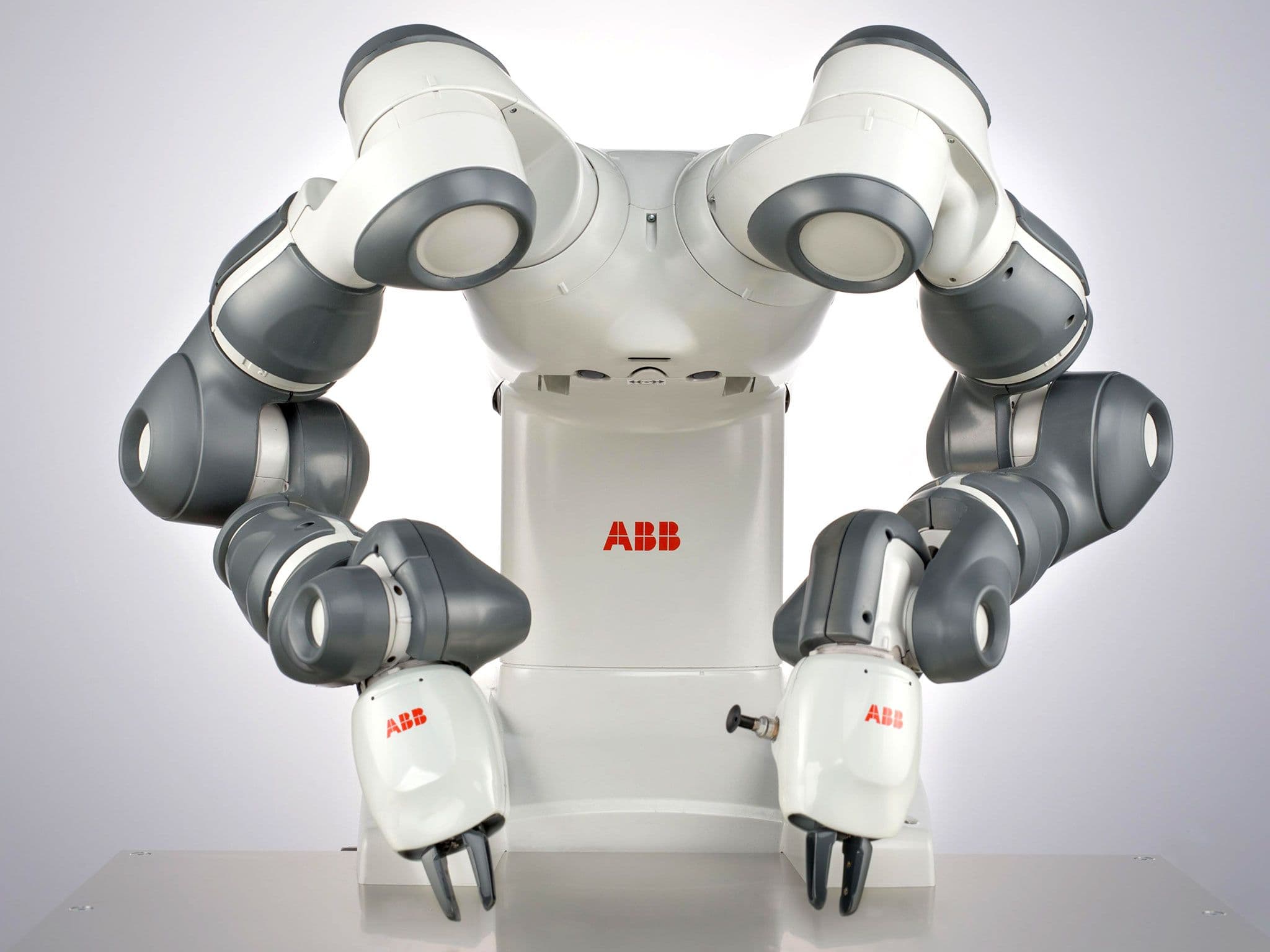
Baxter was a dual-arm collaborative robot introduced by Rethink Robotics, the Boston-based company co-founded by iRobot co-founder Rodney Brooks. Unlike traditional caged industrial arms, Baxter was built with compliant, force-sensing arms and integrated safety sensing so it could operate directly alongside human workers without protective barriers. An animated face on its head display communicated where the robot was about to move and its current state, making its behavior more predictable to nearby people.
The robot was aimed at repetitive, low-to-moderate precision factory work such as loading and unloading machines, sorting, packing, and material handling. A defining feature was its training model: a worker with no programming background could teach a new task simply by physically moving the arms through the motion and confirming via on-screen prompts, rather than writing conventional robot code.
Alongside the manufacturing product, Rethink offered a Baxter Research Robot variant with an open software development kit built on ROS, which became widely used in university and corporate research labs. Rethink Robotics ceased operations in 2018 and its assets were sold, so the original Baxter is no longer in production.
RoboZaps maintains this record as part of its canonical robotics database. Specs are source-verified where linked; the record compares public facts across manufacturers rather than representing a single robot maker.
- Spec sources
- 2 linked
- Verification
- Partially verified · 9/10 specs source-verified
- Deployment
- Discontinued
- Last verified
- Jul 17, 2026
Key Features
- Two compliant, force-sensing arms with series-elastic actuators enabling safe operation around people
- Train-by-demonstration setup: tasks taught by hand-guiding the arms instead of programming
- Animated screen face that signals the robot's intent and state to nearby workers
- Integrated sensing including arm cameras, sonar, and joint-level torque sensing
- Research variant with an open, ROS-based software development kit for custom applications
Specifications
Grouped technical data with source detail available on demand.
10 documented values
Mechanics
| Degrees of Freedom | 14Manufacturer confirmedVerified Jul 8, 2026 Rethink Robotics (archived official tech specs) |
|---|---|
| Locomotion | StationaryManufacturer confirmedVerified Jul 8, 2026 Rethink Robotics (archived official tech specs) |
Performance
| Payload Capacity | 5 lb / 2.2 kg per arm, including end effectorManufacturer confirmedVerified Jul 8, 2026 Rethink Robotics (archived official tech specs) |
|---|---|
| Reach | 1210 mmManufacturer confirmedVerified Jul 8, 2026 Rethink Robotics (archived official tech specs) |
| Repeatability | 5 mm Unverified |
Physical
| Height | 3 ft 1 in (~940 mm) without pedestal; 5 ft 10 in - 6 ft 3 in (~1778-1905 mm) with optional adjustable pedestalManufacturer confirmedVerified Jul 8, 2026 Rethink Robotics (archived official tech specs) |
|---|---|
| Weight | 165 lb (~74.8 kg) without pedestal; 306 lb (~138.8 kg) with optional pedestalManufacturer confirmedVerified Jul 8, 2026 Rethink Robotics (archived official tech specs) |
Sensing
| Sensors | Cameras, sonar, torque sensorsManufacturer confirmedVerified Jul 8, 2026 Rethink Robotics (archived official Baxter SDK documentation) |
|---|
Software
| ROS Compatible | YesManufacturer confirmedVerified Jul 8, 2026 Rethink Robotics (archived official Baxter SDK documentation) |
|---|---|
| SDK Support | YesManufacturer confirmedVerified Jul 8, 2026 Rethink Robotics (archived official Baxter SDK documentation) |
Deployment and commercial evidence
Deployment evidence
Baxter Discontinuation — Internal Assessment
Rethink Robotics ceased all operations in October 2018; Baxter is discontinued. Existing units continue operating at customer sites but no new production, support, or parts supply.
Integration & SDK
- ROS support
- Supported
- SDK available
- Supported
- API docs
- View docs (opens in a new tab)
- Supported platforms
- Linux, Ubuntu 14.04, ROS 1 (Indigo), Python
Support & service
Regions
—Support details not available
Evidence & changelog
Sources behind this record and material corrections made over time.
Sources
- Rethink Robotics (archived official Baxter SDK documentation) — cites Sensors, SDK Support, ROS Compatible
- Rethink Robotics (archived official tech specs) — cites Locomotion, Height, Weight, Reach, Payload Capacity, Degrees of Freedom
Media
Manufacturer
Developer of Baxter and Sawyer collaborative robots for manufacturing automation, ceased operations in 2018.
- Headquarters
- Boston, MA, USA
- Founded
- 2008