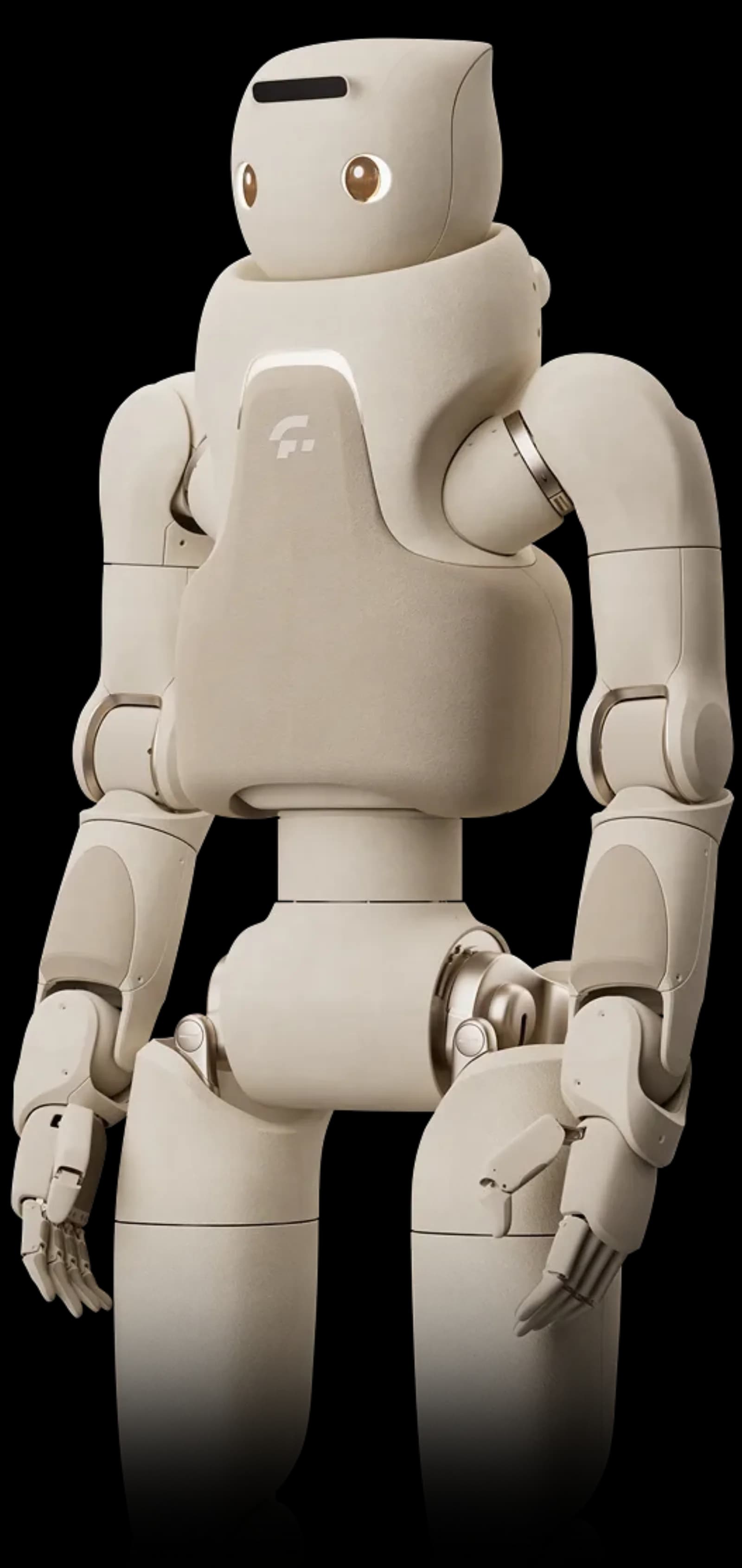
Clone Alpha
Soft-bodied, muscle-driven humanoid android for the home
Price
Price not publicly disclosed
No defensible public pricing observation is documented yet.
Key facts
Values reflect the public record
- Height
- No public data documented
- Weight
- No public data documented
- Payload
- No public data documented
- Degrees of freedom
- No public data documented
- Runtime
- No public data documented
- Max speed
- No public data documented
Canonical robot record
Overview
Clone Alpha is a humanoid android developed by Clone Robotics, built around a biomimetic musculoskeletal architecture rather than conventional rigid actuators. Its soft body is driven by the company's Myofiber artificial muscle technology, which is powered by water and electricity, giving the robot a lightweight, compliant build that the maker likens to a stuffed animal and describes as gentle enough not to damage floors.
The android is designed to walk naturally and to interact through plain-language conversation, with onboard GPU-enabled edge computing handling its robotics workloads. Clone positions it as a domestic companion capable of learning and carrying out common household chores, with a training workflow that lets owners demonstrate a task once so the robot can repeat it thereafter.
Clone Alpha is being offered as a limited Alpha Edition reservation, framed as among the first units the company will produce. Detailed dimensional specifications and pricing are not published on the manufacturer's own product or pre-order pages.
RoboZaps maintains this record as part of its canonical robotics database. Specs are source-verified where linked; the record compares public facts across manufacturers rather than representing a single robot maker.
- Spec sources
- 2 linked
- Verification
- Verified · 4/4 specs source-verified
- Deployment
- Announced
- Last verified
- Jul 17, 2026
Key Features
- Soft-bodied, biomimetic build driven by water-powered Myofiber synthetic muscles
- Walks naturally and converses in plain language
- Onboard GPU-enabled edge computing for robotics
- Designed to learn and perform everyday household tasks via a teach-once workflow
- Powered by water and electricity only
- Offered as a limited Alpha Edition reservation
Specifications
Grouped technical data with source detail available on demand.
4 documented values
Commercial
| Availability Status | Preorder openManufacturer confirmedVerified Jul 17, 2026 Clone Robotics |
|---|---|
| Deployment Status | AnnouncedManufacturer confirmedVerified Jul 17, 2026 Clone Robotics |
Compute
| Compute | GPU-based edge computing; processor not disclosedManufacturer confirmedVerified Jul 17, 2026 Clone Robotics |
|---|
Mechanics
| Locomotion | BipedalManufacturer confirmedVerified Jul 17, 2026 Clone Robotics |
|---|
Deployment and commercial evidence
Deployment evidence
Clone Alpha Pre-order
Clone Robotics says it plans a limited Alpha Edition run of 279 units and maintains a pre-order/reservation page. The current official evidence supports an announced/pre-order program, not delivered customer units or commercial deployment.
Evidence & changelog
Sources behind this record and material corrections made over time.
Sources
- Clone Alpha Pre-order · Clone Robotics — cites Deployment Status, Degrees of Freedom, Weight, Height, Availability Status, Sensors
- Clone Android · Clone Robotics — cites Locomotion, Compute
Manufacturer
Developer of bio-inspired humanoid robots using artificial muscles and musculoskeletal design.
- Headquarters
- Warsaw, Poland
- Founded
- 2021