Atlas 2024
All-electric humanoid robot for industrial work
Price
Price not publicly disclosed
No defensible public pricing observation is documented yet.
Key facts
Values reflect the public record
- Height
- 1.9 mManufacturer confirmed
- Weight
- 90 kgManufacturer confirmed
- Payload
- 50 kg (instant) / 30 kg (sustained)Manufacturer confirmed
- Degrees of freedom
- 56Manufacturer confirmed
- Runtime
- 4 hrManufacturer confirmed
- Max speed
- No public data documented
Canonical robot record
Overview
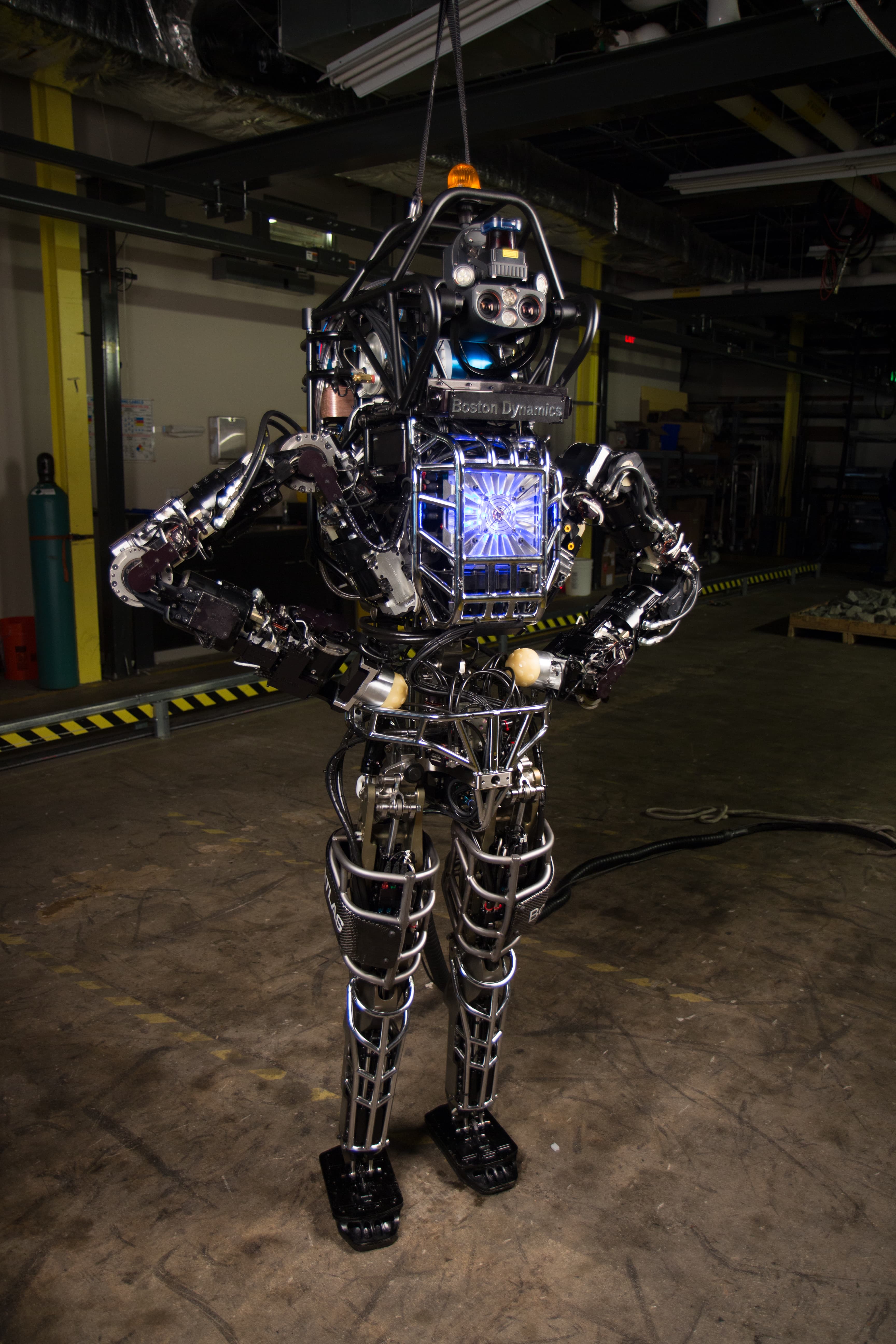
Atlas is Boston Dynamics' all-electric humanoid robot, the successor to its earlier hydraulic research platform. Unveiled in 2024 as a fully electric machine, it is engineered to operate in real industrial settings such as warehouses and automotive factories, moving through the same workstations and using the same equipment as human staff.
The robot combines dexterous manipulation with tactile and camera-based sensing to handle a wide range of material-handling and fulfillment tasks. It is built on recent AI advances, allowing it to learn new skills quickly, adapt to dynamic environments, and operate autonomously with minimal supervision. Once one unit learns a task, that skill can be deployed across an entire fleet.
Boston Dynamics positions Atlas as enterprise-ready and integrates it with its Orbit fleet-management platform alongside its Spot and Stretch robots. The company is rolling it out to a select group of early-adopter customers, including a field-testing pilot with Hyundai on real-world sequencing tasks.
RoboZaps maintains this record as part of its canonical robotics database. Specs are source-verified where linked; the record compares public facts across manufacturers rather than representing a single robot maker.
- Spec sources
- 1 linked
- Verification
- Verified · 9/9 specs source-verified
- Deployment
- Paid Deployment
- Last verified
- Jul 8, 2026
Key Features
- Fully electric humanoid design built to operate within existing human workstations and equipment
- Dexterous manipulation with tactile fingers and palm plus 360-degree camera-based vision
- AI-driven task learning that can be shared and deployed across an entire fleet
- Continuous operation via autonomous navigation to a charging station and self-swapping of its own battery
- Fenceless safety system with human detection, plus integration with the Orbit fleet-management platform
Specifications
Grouped technical data with source detail available on demand.
9 documented values
Environment
| IP Rating | IP67Manufacturer confirmedVerified Jul 8, 2026 Boston Dynamics |
|---|
Mechanics
| Degrees of Freedom | 56Manufacturer confirmedVerified Jul 8, 2026 Boston Dynamics |
|---|---|
| Locomotion | BipedalManufacturer confirmedVerified Jul 8, 2026 Boston Dynamics |
Performance
| Payload Capacity | 50 kg (instant) / 30 kg (sustained)Manufacturer confirmedVerified Jul 8, 2026 Boston Dynamics |
|---|---|
| Reach | 2.3 mManufacturer confirmedVerified Jul 8, 2026 Boston Dynamics |
Physical
| Height | 1.9 mManufacturer confirmedVerified Jul 8, 2026 Boston Dynamics |
|---|---|
| Weight | 90 kgManufacturer confirmedVerified Jul 8, 2026 Boston Dynamics |
Power
| Runtime | 4 hrManufacturer confirmedVerified Jul 8, 2026 Boston Dynamics |
|---|
Sensing
| Sensors | Tactile sensing, 360° camera view (machine vision)Manufacturer confirmedVerified Jul 8, 2026 Boston Dynamics |
|---|
Deployment and commercial evidence
Deployment evidence
Electric New Era for Atlas — Boston Dynamics
Boston Dynamics retired the hydraulic Atlas and unveiled a fully electric version in April 2024, beginning pilot testing with Hyundai Motor Group.
Integration & SDK
- ROS support
- Not confirmed
- SDK available
- Not confirmed
- API docs
- —
- Supported platforms
- —
Support & service
Regions
—Support details not available
Evidence & changelog
Sources behind this record and material corrections made over time.
Sources
- Boston Dynamics — cites IP Rating, Battery Life, Payload Capacity, Reach, Degrees of Freedom, Weight, Height, Sensors, Locomotion
Record changelog
- Deployment: — changed to Boston Dynamics' Robotics Metaplant Application Center (RMAC) at Hyundai Motor Group Metaplant America moved from pilot testing to full operations, training Atlas for parts logistics and sequencing · Sep 25, 2026
Boston Dynamics' own announcement (wire-distributed) confirms RMAC at Hyundai's Metaplant reached full operations, training Atlas on real manufacturing tasks.
Media
Manufacturer
Leading developer of advanced mobile robots including Spot, Stretch, and Atlas for industrial and research applications.
- Headquarters
- Waltham, MA, USA
- Founded
- 1992