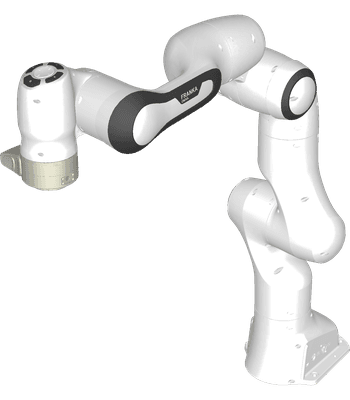
Franka Emika Panda
Sensitive 7-axis collaborative research robot arm
Price
Historical record
No current purchase price is documented.
Key facts
Values reflect the public record
- Height
- No public data documented
- Weight
- ~17.8 kgManufacturer confirmed
- Payload
- 3 kgManufacturer confirmed
- Degrees of freedom
- 7Manufacturer confirmed
- Runtime
- No public data documented
- Max speed
- 2 m/sManufacturer confirmed
Canonical robot record
Overview
The Franka Emika Panda is a collaborative robot arm built by the Munich-based company Franka Emika (now Franka Robotics, part of Agile Robots). It is distinguished by torque sensors in every joint, giving it high force sensitivity and the ability to work safely alongside people and in contact-rich tasks.
The Panda became a standard platform across robotics and AI research and education, valued for its intuitive teaching, programmability, and open research interface. It was paired with an ecosystem of grippers, software, and control tooling.
Franka has withdrawn the Panda (also known internally as the FER / Franka Emika Robot) from its portfolio, ending software support and replacing it with successor systems aimed at industrial and research use. Replacement units are only available from remaining stock.
RoboZaps maintains this record as part of its canonical robotics database. Specs are source-verified where linked; the record compares public facts across manufacturers rather than representing a single robot maker.
- Spec sources
- 4 linked
- Verification
- Verified · 21/21 specs source-verified
- Deployment
- Discontinued
- Last verified
- Jul 8, 2026
Key Features
- Torque sensors in all joints for force-sensitive, compliant motion and contact tasks
- Seven-axis articulated design giving human-like dexterity in tight or obstructed spaces
- Intuitive hand-guiding and visual programming for fast teaching without deep robotics expertise
- Open real-time control interface for research, plus an ecosystem of grippers and add-ons
- Collaborative operation designed to work safely in shared human workspaces
Specifications
Grouped technical data with source detail available on demand.
21 documented values
Connectivity
| Communication | EthernetManufacturer confirmedVerified Jul 8, 2026 Franka Emika (archived franka.de datasheet) |
|---|---|
| Tool I/O | End-effector connector (power + comms to Franka Hand); DIN ISO 9409-1-A50 tool flange; no configurable digital/analog flange I/OManufacturer confirmedVerified Jul 13, 2026 Franka Emika |
Environment
| IP Rating | IP30Manufacturer confirmedVerified Jul 8, 2026 Franka Emika (archived franka.de datasheet) |
|---|---|
| Operating Temperature | 15–25 °C typical (5–45 °C extended, reduced performance)Manufacturer confirmedVerified Jul 13, 2026 Franka Emika |
| Noise level | ≤70 dB (system limit per Machinery Directive 2006/42/EC)Manufacturer confirmedVerified Jul 13, 2026 Franka Emika |
Mechanics
| Degrees of Freedom | 7Manufacturer confirmedVerified Jul 8, 2026 Franka Emika (archived franka.de datasheet) |
|---|---|
| Locomotion | StationaryManufacturer confirmedVerified Jul 8, 2026 Franka Emika (archived franka.de datasheet) |
| Actuators | 7 revolute joints; link-side torque sensors in all 7 axesManufacturer confirmedVerified Jul 13, 2026 Franka Robotics |
Performance
| Max Speed | 2 m/sManufacturer confirmedVerified Jul 8, 2026 Franka Emika (archived franka.de datasheet) |
|---|---|
| Payload Capacity | 3 kgManufacturer confirmedVerified Jul 8, 2026 Franka Emika (archived franka.de datasheet) |
| Reach | 855 mmManufacturer confirmedVerified Jul 8, 2026 Franka Emika (archived franka.de datasheet) |
| Repeatability | <±0.1 mm pose repeatability (ISO 9283)Manufacturer confirmedVerified Jul 8, 2026 Franka Emika (archived franka.de datasheet) |
| Max joint torque | 87 N·m (joints 1–4), 12 N·m (joints 5–7)Manufacturer confirmedVerified Jul 13, 2026 Franka Robotics |
Physical
| Weight | ~17.8 kgManufacturer confirmedVerified Jul 8, 2026 Franka Emika (archived franka.de datasheet) |
|---|
Power
| Power consumption | ≈60 W typical, 350 W max (arm); ~80 W control unitManufacturer confirmedVerified Jul 13, 2026 Franka Emika |
|---|---|
| Power supply | 100–240 VAC, 47–63 HzManufacturer confirmedVerified Jul 13, 2026 Franka Emika |
Safety
| Safety functions | Torque-sensor collision detection (<2 ms); designed to EN ISO 10218-1/-2 and EN ISO 13849-1; PL d Cat 3 only via safety retrofit + safety-rated PLCManufacturer confirmedVerified Jul 13, 2026 Franka Emika |
|---|
Sensing
| Sensors | Joint torque sensorsManufacturer confirmedVerified Jul 8, 2026 Franka Emika (archived franka.de datasheet) |
|---|
Software
| ROS Compatible | YesManufacturer confirmedVerified Jul 8, 2026 Franka Robotics (frankaemika.github.io) |
|---|---|
| SDK Support | YesManufacturer confirmedVerified Jul 8, 2026 Franka Emika (archived franka.de datasheet) |
| Controller | Franka Control unit; Desk web programming + Franka Control Interface (FCI, 1 kHz real-time) via libfranka / franka_rosManufacturer confirmedVerified Jul 13, 2026 Franka Robotics |
Deployment and commercial evidence
Deployment evidence
Franka Research 3 — Official Product Page
The Franka Research 3 (successor to the Panda) is available through distributors including Clearpath Robotics at ~$30,000 USD; widely used in research institutions worldwide.
franka_ros — Official ROS Integration
Official ROS/ROS 2 packages for the Franka robot arm with 1kHz real-time control, MoveIt2 integration, and complete URDF models.
Integration & SDK
- ROS support
- Supported
- SDK available
- Supported
- API docs
- View docs (opens in a new tab)
- Supported platforms
- Linux, Ubuntu 20.04, Ubuntu 22.04, ROS 1 (Noetic), ROS 2, C++, Python, MATLAB/Simulink
Support & service
Regions
| Tier | Response time | SLA |
|---|---|---|
| Standard | 72 hrs | — |
Evidence & changelog
Sources behind this record and material corrections made over time.
Sources
- Franka Emika (archived franka.de datasheet) — cites IP Rating, Max Speed, Locomotion, Sensors, Communication, SDK Support, Repeatability, Reach, Payload Capacity, Degrees of Freedom, Weight
- Franka Robotics (frankaemika.github.io) — cites ROS Compatible
- Franka Control Interface — robot specifications & limits · Franka Robotics — cites Max joint torque, Actuators, Controller
- Franka Emika Panda datasheet · Franka Emika — cites Power supply, Power consumption, Operating Temperature, Safety functions, Tool I/O, Noise level
Media
Manufacturer
German manufacturer of collaborative robots for industrial automation and research applications.
- Headquarters
- Munich, Germany
- Founded
- 2016