Ameca
The World's Most Advanced Humanoid Robot
Contact for pricing
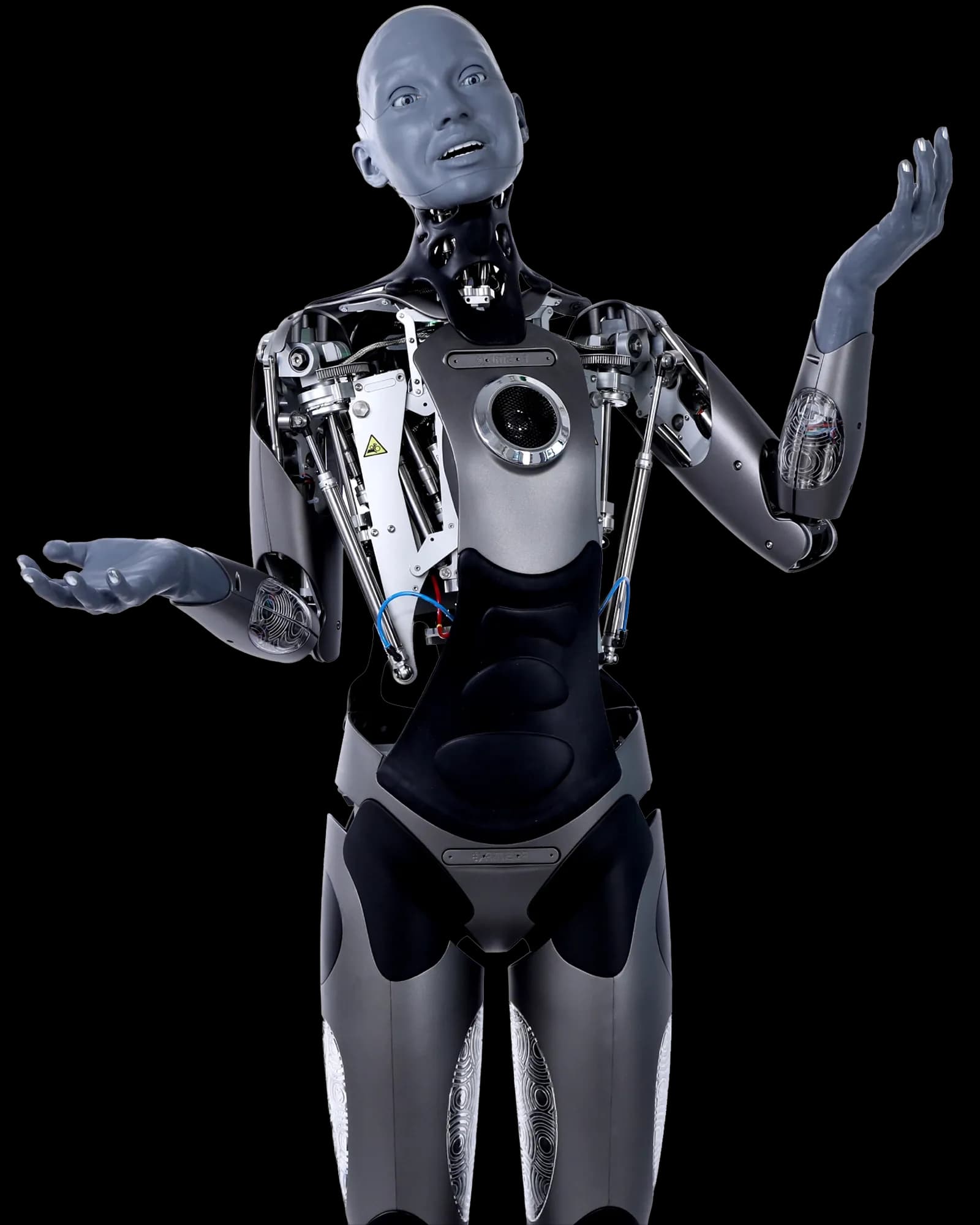
Ameca is a humanoid robot platform developed by Engineered Arts (Falmouth, Cornwall, UK), widely regarded as the world's most expressive humanoid robot commercially available. First revealed in December 2021 and demonstrated at CES 2022, Ameca uses Mesmer technology with dozens of individually actuated facial motors to produce 61 degrees of freedom total — including 27 in the face alone. Generation 3 launched at ICRA 2025, deployed at the National Robotarium Edinburgh, Museum of the Future Dubai, Computer History Museum, and several major European science centers.
Released: 2021
Overview
Ameca represents the cutting edge of humanoid robotics, combining advanced mechatronics with cloud-based AI to create one of the most expressive and lifelike robots ever built. Unveiled in late 2021 by UK-based Engineered Arts, Ameca is built on the company's Tritium platform and features a modular design that allows for upgrades and customization. The robot's grey, gender-neutral appearance was deliberately chosen to avoid uncanny valley effects while maintaining an approachable, futuristic aesthetic.
Unlike mobile humanoid robots focused on locomotion and manipulation tasks, Ameca is designed specifically for human interaction and as a development platform for artificial intelligence. With 52 degrees of freedom distributed across the upper body, arms, hands, and particularly the face, Ameca can produce remarkably natural facial expressions, eye movements, and gestures. This makes it ideal for research into human-robot communication, emotion recognition, and social robotics.
Ameca runs on Engineered Arts' proprietary Tritium operating system and is designed to integrate with various AI frameworks and cloud services. The platform is hardware-ready for future upgrades, including the potential addition of legs for mobility. Organizations can lease or purchase Ameca for research, exhibition, or commercial applications where realistic human-robot interaction is required.
Key Features
- Facial Expression System: 27 actuators in the head and neck enable highly realistic facial expressions including smiling, frowning, surprise, and subtle emotional nuances
- Advanced Eye Mechanism: Articulated eyes with eyelids can track faces, make eye contact, and perform natural eye movements including blinking and saccades
- Upper Body Articulation: 52 total degrees of freedom across shoulders, arms, hands, and torso allow for natural human-like gestures and body language
- Modular Architecture: Built on Tritium platform with upgradeable hardware components including potential for adding leg modules
- AI-Ready Platform: Compatible with multiple AI frameworks, cloud-based processing, and custom software development for conversational AI and interaction behaviors
- Embedded Sensors: Cameras in each eye for vision, microphones for audio input, and chest-mounted camera for spatial awareness
- Real-Time Control: Low-latency control system enables responsive, natural interaction with sub-100ms reaction times
Applications
Ameca serves multiple roles across research, entertainment, and commercial sectors. In academic and corporate research environments, Ameca provides a sophisticated platform for developing and testing AI algorithms for natural language processing, emotion recognition, and human-robot interaction protocols. Universities and tech companies use Ameca to study how humans respond to humanoid robots and to develop more intuitive interfaces between people and machines. The robot has also appeared at numerous technology exhibitions, trade shows, and museums where it serves as an interactive exhibit, engaging visitors in conversations and demonstrations of cutting-edge robotics.
In commercial settings, Ameca can function as a sophisticated brand ambassador, information kiosk, or customer service representative in high-end retail, hospitality, or corporate environments. Entertainment venues and theme parks have shown interest in deploying Ameca-class robots for interactive experiences. The platform is also valuable for companies developing conversational AI and want to test their systems with a physical embodiment that can provide full multimodal interaction including speech, facial expressions, and gestures.
Technical Highlights
The most striking technical achievement of Ameca is its facial animation system, which represents some of the most advanced work in humanoid expressiveness. The 27 actuators controlling facial features are precisely coordinated to produce expressions that convey emotion in ways that feel natural to human observers. The eye mechanism deserves particular attention—each eye can move independently with high precision, track multiple targets, and coordinate with eyelids and eyebrows to create genuine-seeming emotional states. This level of expressiveness is critical for establishing trust and rapport in human-robot interactions.
Engineered Arts' Tritium platform underlying Ameca provides a robust, modular foundation that separates mechanical hardware, low-level control, and high-level AI processing. This architecture allows researchers to focus on AI development without worrying about motor control details, while still maintaining the option for deep customization. The platform's cloud-connected nature means Ameca can leverage powerful remote processing for complex AI tasks while maintaining real-time responsiveness for interaction. The robot's design also emphasizes maintainability and upgradeability, with easily accessible components and a forward-looking hardware architecture that can accommodate future enhancements including potential locomotion systems.
The World's Most Expressive Humanoid Platform
Ameca is engineered as the gold standard for human-robot interaction research and public-facing installations. Its primary innovation is an extraordinarily lifelike face capable of expressing surprise, curiosity, joy, skepticism, and subtle micro-expressions through Mesmer technology. The robot is deliberately genderless and non-threatening, with grey rubber skin on the face and hands and a clearly robotic metallic body. Ameca integrates with modern LLMs including GPT-4, Claude, and Gemini via the Tritium 3 OS. A custom Ameca-based humanoid named 'Aura' was built for the Sphere venue in Las Vegas.
Key Capabilities
- 61 total DOF: 27 face, 5 neck, 18 shoulders/arms, 8 hands, 3 torso
- Mesmer technology — dozens of individually actuated facial motors for micro-expressions
- GPT-4, Claude, and Gemini integration via Tritium 3 OS
- Binocular eye cameras, chest camera, RGB-D depth camera, LiDAR, IMU
- Facial recognition and individual visitor identification within sessions
- Telepresence/remote operation via cloud connectivity
- REST and WebSocket API for custom behavior development
- Modular: available as head-only, half-body, or full humanoid
- 2 kg carrying capacity per arm
- 50+ distinct human expressions
Tritium OS and AI Integration
Ameca runs on Tritium 3 software providing comprehensive behavior control, cloud services connectivity, and full API access. The system supports Wi-Fi and Ethernet, with LLM integration for natural conversations. The sensor suite includes embedded microphones, gyroscope, accelerometer, joint encoders, and RGB-D depth camera. Ameca supports OpenAI API integration, custom model deployment, and telepresence mode for remote operation.
Proven Real-World Deployments
As of early 2026, Ameca is deployed at: National Robotarium (Edinburgh, UK) — permanent installation; Museum of the Future (Dubai, UAE) — interacting with thousands of visitors daily; Computer History Museum (Mountain View, CA); Heinz Nixdorf MuseumsForum (Paderborn, Germany); Copernicus Science Center (Warsaw, Poland); and Deutsches Museum (Nuremberg, Germany). Ideal buyers include museums, science centers, research institutions, corporate event organizers, and universities studying human-robot interaction.
Videos
Specifications
Connectivity
| Communication | Ethernet, WiFi |
Mechanics
| Degrees of Freedom | 52 |
| Locomotion | Stationary |
Physical
| Height | 1780 mm |
Sensing
| Sensors | Cameras in eyes, microphones, facial tracking |
Similar Robots
Ready to deploy Ameca?
Tell us about your use case and we'll help you evaluate this solution.