Nao
Humanoid robot for education, research and healthcare
Price
$16,990
Legacy record price · Jul 8, 2026
Key facts
Values reflect the public record
- Height
- 574 mmManufacturer confirmed
- Weight
- 5.48 kgManufacturer confirmed
- Payload
- No public data documented
- Degrees of freedom
- 25Manufacturer confirmed
- Runtime
- 90 min (normal use) / 60 min (active use)Manufacturer confirmed
- Max speed
- No public data documented
Canonical robot record
Overview
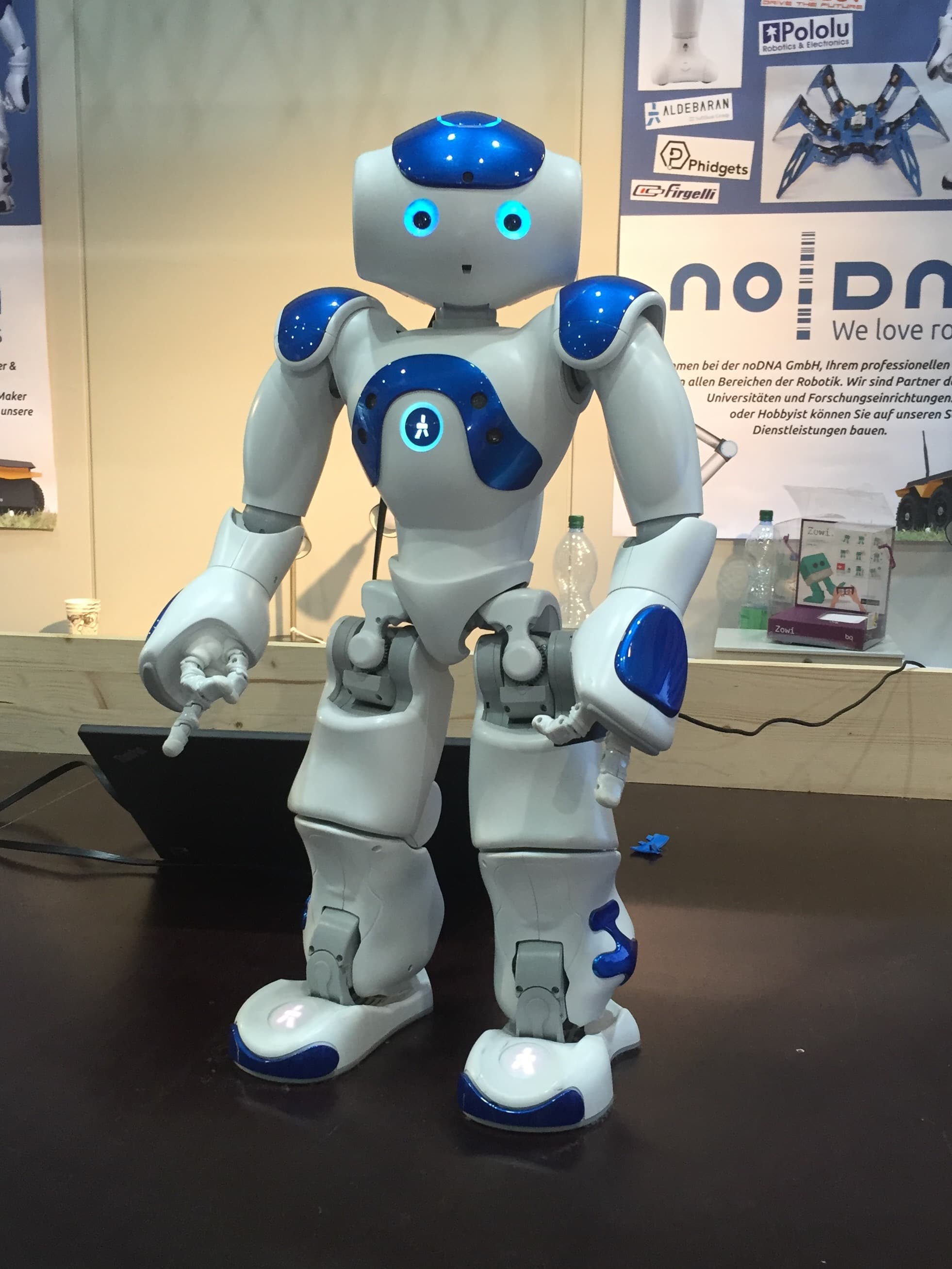
Nao is a compact autonomous humanoid robot designed to interact naturally with people. Its current generation, NAO6, is positioned for education, research, healthcare and elderly-care environments, where it engages users through expressive movement, speech and social behaviour.
The robot perceives its surroundings using onboard cameras, microphones, tactile sensors, sonars and an inertial measurement unit, allowing it to see, hear, sense touch and keep its balance. These sensing abilities are paired with smooth, expressive whole-body motion and functional hands.
Nao is fully programmable. Developers and educators can build behaviours with the Choregraphe low-code visual tool or with Python and C++ software development kits, and the platform supports multilingual speech, computer vision and integration with generative AI. It is now developed and supported by Maxtronics, the France-based successor to Aldebaran.
RoboZaps maintains this record as part of its canonical robotics database. Specs are source-verified where linked; the record compares public facts across manufacturers rather than representing a single robot maker.
- Spec sources
- 3 linked
- Verification
- Partially verified · 8/9 specs source-verified
- Deployment
- Scaled Deployment
- Last verified
- Jul 8, 2026
Key Features
- Expressive whole-body humanoid motion with functional hands
- Rich multimodal sensing via cameras, microphones, tactile sensors, sonars and an inertial unit
- Multilingual speech, computer vision and generative-AI integration
- Fully programmable through Choregraphe visual tooling plus Python and C++ SDKs
- Designed for education, research, healthcare and elderly-care use
Specifications
Grouped technical data with source detail available on demand.
11 documented values
Connectivity
| Communication | WiFi, EthernetManufacturer confirmedVerified Jul 8, 2026 Aldebaran/Maxtronics (official NAO6 knowledge base) |
|---|
Mechanics
| Degrees of Freedom | 25Manufacturer confirmedVerified Jul 8, 2026 Maxtronics (official NAO6 product page) |
|---|---|
| Locomotion | Bipedal Unverified |
Physical
| Height | 574 mmManufacturer confirmedVerified Jul 8, 2026 Aldebaran/Maxtronics (official NAO6 knowledge base) |
|---|---|
| Weight | 5.48 kgManufacturer confirmedVerified Jul 8, 2026 Aldebaran/Maxtronics (official NAO6 knowledge base) |
| Width | 275 mm Unverified |
| Depth | 311 mm Unverified |
Power
| Runtime | 90 min (normal use) / 60 min (active use)Manufacturer confirmedVerified Jul 8, 2026 Aldebaran/Maxtronics (official NAO6 knowledge base) |
|---|
Sensing
| Sensors | 2 cameras, 4 microphones, sonar, tactile sensors, inertial unitManufacturer confirmedVerified Jul 8, 2026 Aldebaran/Maxtronics (official NAO6 knowledge base) |
|---|
Software
| ROS Compatible | YesThird-party sourceVerified Jul 8, 2026 ros-naoqi (GitHub) |
|---|---|
| SDK Support | YesManufacturer confirmedVerified Jul 8, 2026 Maxtronics (official NAO6 product page) |
Deployment and commercial evidence
Deployment evidence
NAO Robot — Wikipedia
NAO has been deployed in 70+ countries with 19,000+ units, primarily in education and research; used in RoboCup competitions and university robotics programs worldwide.
Integration & SDK
- ROS support
- Supported
- SDK available
- Supported
- API docs
- View docs (opens in a new tab)
- Supported platforms
- Linux, ROS 1 (Melodic, Noetic), Python, C++, Java, JavaScript
Support & service
Regions
| Tier | Response time | SLA |
|---|---|---|
| Standard | 72 hrs | — |
Evidence & changelog
Sources behind this record and material corrections made over time.
Sources
- Aldebaran/Maxtronics (official NAO6 knowledge base) — cites Height, Weight, Battery Life, Sensors, Communication
- Maxtronics (official NAO6 product page) — cites Degrees of Freedom, SDK Support
- ros-naoqi (GitHub) — cites ROS Compatible
Media
Manufacturer
Creator of NAO and Pepper humanoid robots for education, research, and customer service applications.
- Headquarters
- Paris, France
- Founded
- 2005